Open standards
Connect the journal to the open web
Your journal has an address of its own, and open standards let other places speak to it without asking everyone to join the same service. On Moments, that connection has three parts: RSS for subscribing, the Fediverse for following and replies, and Webmentions for responses published on independent sites.
RSS is available to every public journal. The interactive open web connection is included with Moments Plus. See plans and pricing.
Three quiet connections
- RSS is available for every public journal and carries recent public moments to feed readers in order.
- The Fediverse gives an enabled journal a followable address for Mastodon and compatible apps.
- Webmentions let another website notify a conversational moment that it has linked back.
Enable only what you mean to use
RSS needs no journal switch. The interactive Open web connection is optional and part of Moments Plus. Enabling it gives the journal a Fediverse identity, but it does not broadcast the back catalogue or every future public moment.
Distribution remains a moment-level choice. Only a public moment explicitly shared beyond the journal can travel to the community and open-web followers. Conversation is also enabled per eligible moment, so some entries can invite replies while others remain quiet.
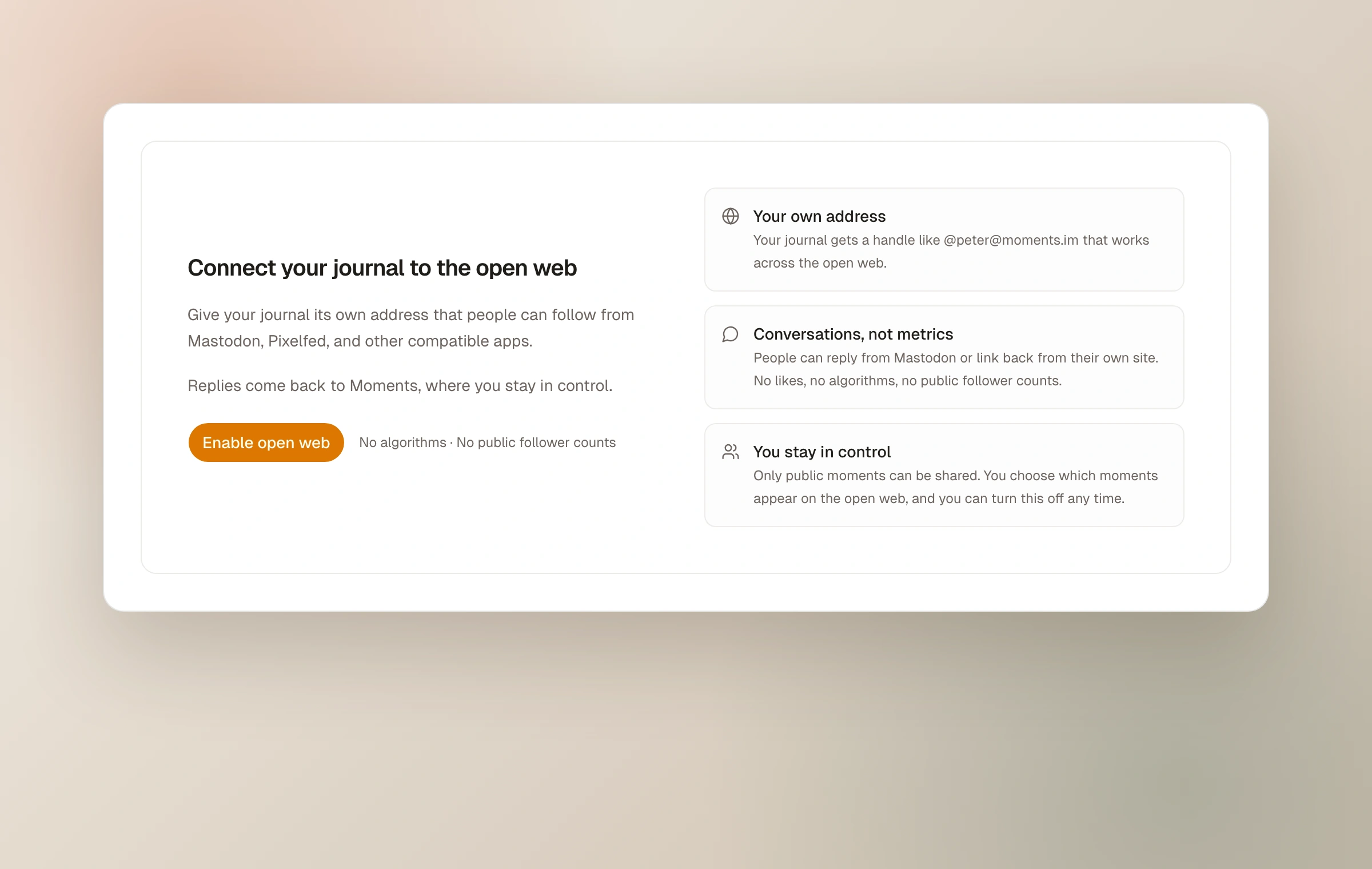
Use the Open web hub
The dashboard's Open web area shows the journal's handle and groups the activity that needs your attention. Conversation contains Fediverse replies; Webmentions contains verified links from other sites; Shared moments records what was sent; People shows followers; and Blocked holds actors or domains you chose not to hear from.
Replies and mentions are words, not counters. There are no public follower totals, like totals, or algorithmic ranking to tend.
Pause or turn it off
You can turn Open web off from the dashboard. If paid access lapses while it is enabled, federation is paused while the identity and followers remain intact, making a later return less destructive. Existing public journal pages and their RSS feed are separate from that paid interactive connection.
Remote networks are independent systems. Removing or retracting a shared moment tells them about the change, but a remote server may retain a cached or previously received copy.
Keep reading
Related guide
Fediverse following and conversation
Let people follow from Mastodon and compatible apps, choose which moments reach them, and manage the replies that return.
Related guide
Receive Webmentions
Understand verified mentions from independent websites and moderate what appears beneath a moment.
Related guide
Follow journals with RSS
Use the automatic chronological feed available on every public journal, with no account and no algorithm.
Related guide
Share directly or with the community
Use stable links, decide what joins the chronological community feed, and keep public from meaning performative.